☰: Cyclocopter
Also cyclogyro.
Cyclocopter is a copter based on Cyclorotor as a main propulsion system.
Wikipedia: https://en.wikipedia.org/wiki/Cyclogyro
Video explaining cyclocopters with demonstration of an actual flying model: https://www.youtube.com/watch?v=JoVmejDsMrM
Video explaining cyclocopters with a deep historic overview: https://www.youtube.com/watch?v=Lqy_7lr6wuE
Videos of the first flying cyclocopters:

Full-electric cyclocopter. Also horizontal omnicopter.
Status: Designing
Site: https://www.cyclotech.at/future-applications

Company: Cyclotech
Future crewed prototype developed by Cyclotech.
See unmanned scaled prototype: Cyclotech BlackBird Demonstrator
Specifications:
- Range: 100km
- Payload: 200kg
- Max speed: 150km/h
- Redundancy: allow 1 rotor failure
Full-electric cyclocopter. Also horizontal omnicopter.
Scaled prototype of Cyclotech CruiseUp
Instead of Cyclotech Technology Demonstrator with 4 cyclorotor, the BlackBird uses 6 in configuration, which allows to move any direction in horizontal plane without yaw.
The BlackBird is a horizontal omnicopter, as it does not tilt during acceleration/braking/sliding and can move sideways without yaw.
The BlackBird can also be a partial omnicopter, as it can maintain static stability at any pitch angle.
Site: https://www.cyclotech.at/rotor-solutions
Status: Testing

Company: Cyclotech
- Move: 3 axis
- Rotation: 2 axis
News: https://www.cyclotech.at/news/newsroom/blackbird-demonstrator-maiden-flight
Video of first flight: https://www.youtube.com/watch?v=8OUyR9pCiVs (2025-03-27)
Full-electric cyclocopter.
Project highlights thrust-vectoring design similar to JetQuad or https://en.wikipedia.org/wiki/Bell_X-22.
First scaled prototype developed by Cyclotech.
Demonstrator uses 4 cyclorotors.
Demonstrator has compound helicopter like capabilities, as it does not tilt during acceleration/braking.
Demonstrator can also be a partial single-axis omnicopter (if it has enough thrust), as it can maintain static stability while rotating 360 degrees on the pitch axis, but that properties does not tested.
Status: Dismissed
Site: https://www.cyclotech.at/rotor-solutions

Company: Cyclotech
- Move: 2 axis
- Rotation: 2 axis
Video of first flight: https://www.youtube.com/watch?v=I2qkhmz4z1E (2021-10-05) Video of last flight: https://www.youtube.com/watch?v=oYOZYsHs7_Q (2024-12-19)
News: https://www.cyclotech.at/news/newsroom/cyclotech-starts-outdoor-flying>
Feasibility study of full-electric cargo horizontal omnicopter.
Status: Cancelled
Site: https://www.cyclotech.at/future-applications

Company: Cyclotech
- Move: 2 axis
- Rotation: 2 axis
Specifications:
- Payload: 45kg
- Range: 40km
- Wind Resistance: 36.5knots
- Dimensions: 2.7x2.5m
A series of experimental cyclocopters.
Status: Unknown
Videos: https://www.youtube.com/@cyclocopter
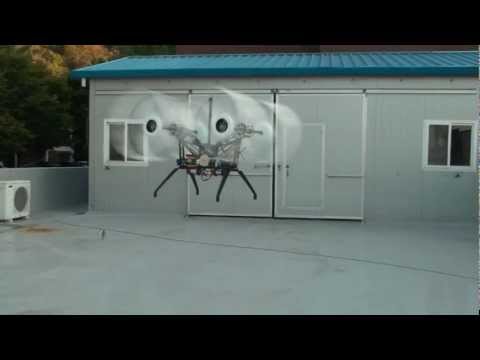
Research center: Seoul National University
Note: The helicopter-like version from papers can be possible largest ever flying cyclocopter, but I can't find info on it.
-
Design of an Effective Cycloidal Blade System and its Applications (2016-02)
Lee, Chung-Hee
Seoul National University, Department of Mechanical and Aerospace Engineering
Keywords: Cycloidal blade system; Vertical take-off and landing; Cyclocopter; Vertical Axis Wind Turbine
https://s-space.snu.ac.kr/handle/10371/118494 https://s-space.snu.ac.kr/bitstream/10371/118494/1/000000131885.pdf,
-
DESIGN AND EXPERIMENT OF TWO-ROTORED UAV CYCLOCOPTER (2014-07-25)
Choong Hee Lee, Seung Yong Min, Jong Won Lee, Seung Jo Kim
Seoul National University, Korea Aerospace Research Institute
Keywords: Cyclocopter, Cyclogyro, UAV, VTOL
https://www.icas.org/icas_archive/ICAS2014/data/papers/2014_0725_paper.pdf
- Wheatley, J.B., “Simplified Aerodynamic Analysis of the Cyclogiro Rotating-wing System,” NACA Technical Notes No.467, August 1933.
- Wheatley, J.B. and Windler, R., “Wind-tunnel Tests of a Cyclogiro Rotor,” NACA Technical Notes No.528, May 1935.
- Kirsten, F.K., “Cycloidal Propulsion Applied to Aircraft,” Transactions of the American Society of Mechanical Engineers, Vol. 50, No. AER-50-12, 1928.
- Kirsten, F.K., “Cycloidal propulsion in air,” Bulletin No. 79, Engineering Experiment Station Series, University of Washington, March 1935.
- Eastman, F.S., Burkheimer, G., and Cotter, W.E., “Wind Tunnel Tests on a High Pitch Cyclogiro,” UWAL Report No. 191-A, University of Washington Aeronautical Laboratory, Seattle, Washington, June 1943.
- Eastman, F.S., “The Full-Feathering Cyclogiro,” UWAL Report No. 317, University of Washington Aeronautical Laboratory, Seattle, Washington, March 1951.
- Gibbens, R.P. and Boschma, J.H., “Construction and testing of a new aircraft cycloidal propeller,” 13th AIAA Lighter-Than-Air Systems Technology Conference, Norfolk, VA, June 28-July 1, 1999.
- Boschma, J.H., “Modern Aviation Applications for Cycloidal Propulsion,” AIAA, Aircraft, Technology Integration, and Operations Forum, Los Angeles, CA, October 2001.
- Benedict, M., Chopra, I., Ramasamy, M. and Leishman, J.G., “Experimental Investigation of the Cycloidal-Rotor Concept for a Hovering Micro Air Vehicle,” American Helicopter Society 64th Annual Forum Proceedings, April 29 - May 2, 2008.
- Benedict, M., Ramasamy, M., and Chopra, I., "Improving the Aerodynamic Performance of Micro-air-vehicle-scale Cycloidal Rotor: an Experimental Approach." Journal of Aircraft, Vol. 47, (4), 2010, pp. 1117-1125.
- Benedict, M., Ramasamy, M., Chopra, I., and Leishman, J. G., “Performance of a Cycloidal Rotor Concept for Micro Air Vehicle Applications,” Journal of the American Helicopter Society, Vol. 55, (2), April 2010, Paper 022002.
- Benedict, M., Gupta, R., and Chopra, I., "Design, Development and Flight Testing of a Twin-Rotor Cyclocopter Micro Air Vehicle," American Helicopter Society 67th Annual Forum Proceedings, Virginia Beach, VA, 2011.
- PAUL E. HEMKE, “Drag of Wings With End Plates” Langley Memorial Aeronautical Laboratory, National Advisory Committee for Aeronautics, Langley Field, VA, January 20, 1927.
- D. E. Newland. 1971. “Whirling of a Cantilever Elastic Shaft Subjected to External Pressure”. In:Journal Mechanical Engineering Science, Vol. 14 No.1,pp. 11-1